
How Does Fabric Ducting Improve Airflow?

Good airflow is essential in almost every indoor environment. Whether it is an office, school, sports hall, food production facility or warehouse, the way air is distributed affects comfort, temperature consistency and the overall indoor environment. While fans and air handling units move air through a building, the ducting system plays a major role in determining where that air goes and how evenly it is delivered.
Fabric ducting has become an increasingly popular alternative to traditional metal ductwork because it offers greater flexibility when designing airflow. Rather than simply transporting air from one location to another, it can be designed to distribute air in a way that suits the needs of the building and the people using it.
How does fabric ducting distribute air differently?
Traditional metal ductwork often delivers air through a series of grilles or diffusers positioned at intervals along the ceiling. This approach works well in many applications, but it can sometimes create noticeable variations in temperature, particularly if air is concentrated in specific areas.
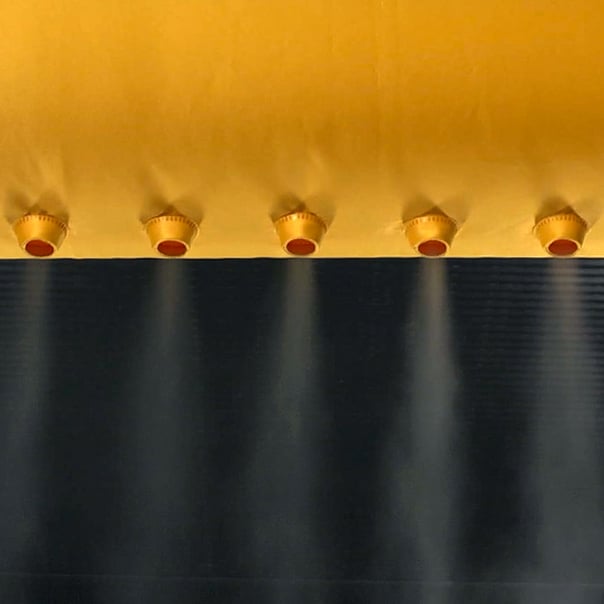
Fabric ducting is designed with carefully positioned perforations, nozzles or permeable materials that allow air to be released evenly along the length of the duct. Instead of delivering airflow from a limited number of outlets, the air is distributed more consistently throughout the space.
This more balanced approach can help reduce areas where people experience draughts while also limiting locations where air movement is minimal.
Why is even airflow important?
Uneven airflow can make a room feel uncomfortable, even when the heating or cooling system is operating correctly.
In an office, some employees may feel cold while others feel too warm. In educational settings, inconsistent temperatures can affect concentration. In manufacturing or food production environments, maintaining stable conditions may also support operational processes.
Improving air distribution helps create a more consistent indoor climate across the entire space rather than concentrating conditioned air in just a few locations.
Can fabric ducting improve heating and cooling performance?
The effectiveness of any ventilation system depends on how efficiently conditioned air reaches occupied areas.
When warm or cool air is distributed evenly, the heating or cooling system can often maintain more stable temperatures throughout the room. This reduces the need for constant adjustments and helps the ventilation system respond more predictably to changing occupancy levels.
The design of the fabric ducting is tailored to each project, taking into account ceiling height, room dimensions, occupancy and the intended use of the building. This allows airflow patterns to be matched more closely to the environment rather than relying on a standard arrangement of vents.
How does fabric ducting adapt to different buildings?
One advantage of fabric ducting is its flexibility. Sports halls often require large volumes of air to be distributed across wide open spaces, while offices may benefit from gentle, low velocity airflow that avoids creating noticeable draughts. Food production facilities may have completely different ventilation requirements again.
Because fabric ducting can be manufactured with different shapes, sizes and air distribution methods, designers can adapt the system to suit each application. This allows airflow to be directed where it is needed while taking account of the activities taking place within the building.
Why does ongoing maintenance matter?
Even the best designed ventilation system requires regular maintenance to continue performing well.
Fabric ducting systems are designed so that the fabric sections can typically be removed for cleaning when required. This can help maintain airflow performance while supporting good indoor hygiene, particularly in environments where cleanliness is an important consideration.
Regular inspections also allow building managers to identify any issues before they begin affecting airflow or occupant comfort.
Ultimately, improving airflow is about more than simply moving air around a building. It involves delivering the right amount of conditioned air, to the right locations, in a consistent and controlled way. Fabric ducting provides designers with greater flexibility to achieve that balance across a wide variety of commercial, industrial and educational environments.
FAQs
How does fabric ducting improve airflow?
Fabric ducting distributes air along the length of the duct using perforations, nozzles or permeable fabric, helping to create more even airflow throughout a space.
Is fabric ducting suitable for both heating and cooling?
Yes. Fabric ducting can be used to distribute both warm and cool air, depending on the design of the ventilation system.
Where is fabric ducting commonly used?
It is widely used in offices, schools, sports halls, warehouses, food production facilities and many other commercial and industrial buildings.
Can fabric ducting reduce draughts?
By distributing air more evenly, fabric ducting can help reduce concentrated airflow that may otherwise create uncomfortable draughts in occupied areas.
Does fabric ducting require maintenance?
Yes. Regular inspections and cleaning help maintain airflow performance and support good indoor hygiene throughout the life of the ventilation system.
Looking for more information?
Our experts are on hand to answer any questions. Why not give us a call or drop us a message, We’ll work with you to find the right solution.
Contact us
